Wednesday, April 23, 2008

Revision: Julian Dibbell's "A Rape in Cyberspace" - Juicy Campus

Our latest reading entitled “A Rape in Cyberspace” by Julian Dibbell was very interesting. The chapter retells the story of Mr. Bungle committing online sexual harassment to two LambdaMOO characters and the issues that arose from the incident. On page 380, we hear legbda’s (one of the raped characters) reaction to the incident. She says, “I tend to think that restrictive measures around here cause more trouble than they prevent” and suggests that Mr. Bungle become “virtually castrated.” In other words, she wants Mr. Bungle’s character destroyed and wiped from the community. She feels his punishment should be to never show his (virtual) face in the online LambdaMOO community ever again.
One question that can be derived from her reaction is: does someone who “virtually” harasses someone in an online community deserve to be banned from that online community? In my opinion, free speech online is free speech. If legba was offended by Mr. Bungle, she should block his comments or just log off when he tries to contact her. For example, the website JuicyCampus.com is becoming increasingly popular among college campuses across America. The website is totally anonymous and encourages enormous amounts of bashing and gossiping.

To learn more about the website, check out this CBS News report about JuicyCampus: http://www.cbsnews.com/stories/2008/03/26/scitech/pcanswer/main3968514.shtml

If someone was gossiping or bashing me on that website, I merely would stop reading the comments because what I don’t read will not bother me. This is how legba should react to Mr. Bungle’s virtual remarks. Because there is such a thing as free speech in this country, it is hard to punish the person writing the criticizing statement on the web. Sometimes it just pays to be the better person and walk away from incident with maturity. There are hundreds of derogatory posts on JuicyCampus written about people that are even harsher than what Mr. Bungle expressed in LambdaMOO. I bet if people didn’t make such a federal case about the “raping”, the whole community would have quickly moved on. The problem here was that the “rape” victims were too enveloped in LambdaMOO that their reactions and emotions got the best of them.

Another point to bring up here is that if people just ignore that they are getting "raped" or bashed online, the act still continues, however they are just ignorant of it. Everyone else can still read what people say about you on JuicyCampus and remind you of it later. Therefore, there is only so much ignoring can do. Also, it is important to mention that free speech isn't 100% granted. There are some limits such as libel and slander. You can be sued for making up false claims and accusations. Perhaps, JuicyCampus will create outrage in the future that many petitions will form and get it shut down. There has to be a way to prove that the website is unethical and at some points can cross the line of free speech.

Revision: Electronic Community: Fox Attacks Bloggers

Our past reading, “Electronic Community: From Birth to Backlash” outlined the creation of the Internet as a web community. I found it very interesting to learn about USENET and IRC chat as an early means of communication during the rise of the Internet. One argument I found particularly interesting, and I bet many people would question the validity of this statement, is “…the Internet is doing just fine…In the short time Blogger has been available, it has fostered an interconnected community of tens of thousands of users. These people don’t simply surf the Web. They are now empowered to create it” (p. 31). He is implying here that the internet in a good state because people aren't just watching content or reading up on things. Rather, they are creating content for people to watch and writing things for people to read.


Most people my age agree that the Internet and blogging are a great way of exercising the use of free speech. Blogs also serve as literature to read as a digital medium. For example, although I do not post very often, I like to read blogs about television, movies and technology. However, according to the video above, FOX News loathes blogging and sees it as an injustice to many industries due to its obscene language. The video shows a montage of clips taken from several FOX news reports where they criticize the act of blogging. The video was created by “Fox attacks”, a blog (interestingly enough) that dedicates itself to hating FOX news. The video relates to Rushkoff's argument in that it down right disagrees with it. The several news anchors and correspondents on FOX news say that people that blog are too critical, mean and bullying. The video also calls bloggers unreliable. I disagree with them (I agree with Rushkoff). Even though some reports are false, blogging is great because it allows anyone to break a reliable news story 24/7 rather than having to wait for a journalist to find the story, write it up, edit it and broadcast it. That is the advantage bloggers have over journalists.

Revision: Neil Postman's "Reach Out and Elect Someone" - Hillary Clinton New Hampshire Primary

I enjoyed reading the latest chapter from Postman entitled “Reach Out and Elect Someone.” The chapter discusses how politics is just like show business in that the main part of a candidates job while running for office is to APPEAR as if they are honest, respectable and hard working through various forms of media such as commercials. According to Postman, “we are inclined to vote for those whose personality, family life, and style are the most favorable among the candidates." I agree with his opinion in that politicians spend a lot of their during campaigns trying to APPEAR to the country that they are well rounded, like to have fun, but also know how to get the job done.

I feel that there are many people out there that know squat about politics but choose to vote based on the values of the candidates seen in the media. For example, I remember hearing a few months ago that Hillary Clinton cried in public showing her compassion for the nation. Immediately following this event, there was mass speculation on several news circuits granting Hillary a victory in gaining more voters just because of her response. This is because Hillary showed that she is human, thus improving her image.

Also, in April, Hillary continued to show how "cool" she is by appearing in college towns and taking shots of whiskey and chugging beers. She is doing this to change her image to make her look cool and hip so people will vote for her. This applies to Postman’s idea (mentioned above) because people who witnessed these events are beginning to sense that she is an empathetic, strong woman who cares about the nation. They are also showing that she is human in that she likes to drink and have a good time. Every leader needs to be able to sit back and enjoy life sometimes.

Friday, April 18, 2008

Blogging from Las Vegas - Extra Credit Blog Post


So...I missed Wednesday's class and quiz to go to Las Vegas to attend the NAB show! This was such an incredible experience because I had the opportunity to learn a lot about the media industry and network with industry professionals.

On Wednesday, I arrived in Vegas at 8am (Vegas time) and went straight to the Las Vegas convention center. I was incredibly overwhelmed by the size of the convention. It was comprised of 3 large halls (about the size of 2 football fields long each). Each hall was divided into specific areas such as media distribution, audio, production equipment, etc. I was able to check out the coolest gadgets coming out in the next year from Adobe, Sony, Panasonic, Cannon, and many others. It was a very hands on experience because I was able to walk up and touch everything I wanted to.

I was in the minority here (young college student) compared to the thousands of industry professionals. They attended the event for their business to check out new equipment and make purchases for their company. I witnessed a lot of schmoozing going on. It was almost creepy because most exhibits have private rooms hidden for deal making.

I also got to attend a couple Apple training labs and learned how to use Apple Motion, Color, and Soundtrack Pro. There were panels during the day and I attended one on the topic of making small budget movies look like they were on a big budget. I learned a lot about production and post skills at the session.

On Thursday, I attended an awards ceremony where I received my scholarship for all my hard work in school, summer internships and campus activities. It was a great honor to receive an award/scholarship in front of hundreds of industry professionals. After the ceremony, several people walked up to me and congratulated me on my accomplishments. They also offered me their business card. I will definitely need to keep in touch with them.

During both evenings I checked out as many hotels as I could. I stayed at the MGM and really enjoyed the hotel. The nicest overall though, I would say is the Venetian. I also saw the Cirque du Soleil show: Ka. It was amazing! Lots of flying, stunts, pyro, and crazyness.

All in all, it was a great trip. I really felt like a business man going on a business trip and it was altogether a great experience. I will definitely attend the NAB show in the future when I am working professionally in the industry. Hopefully, that will not be the next time I return to Vegas. I would love to come back as soon as possible!

Facebook's "Opt-out" Precedent - Future Jobs/Careers

Last week, we focused on several blog posts pertaining to privacy on social networking sites such as Facebook and MySpace. One post I found particularly interesting was a post about the "opt-out" precedent of Facebook. Throughout the last two years, Facebook.com has been limiting member privacy. First, they introduced the newsfeeds. Second, they allowed profiles to be listed on search engines. Now, when members participate in 3rd party websites (such as Blockbuster), a engine known as Beacon will automatically send a notification to your news feed. Of course, Facebook users have the ability to "opt-out" of the three "features" above. However, most users don't know about it because Facebook automatically enabled the features as they were implemented into the website. Therefore, all users were prone to anyone accessing their information until they changed their privacy settings. This was very sneaky on Facebook's party because, as the blog title states: viewers must Opt-out of these features rather than opt-in to being with.

This is very dangerous, not only for general Facebook users, but also college students looking for jobs, internships or career paths. As Facebook created these new features, companies have the ability to find out everything they need to know about you before they offer you a job. They may find out useless knowledge such as a unique hobby you have or see pictures of you in a bad state of mind. After viewing this content, companies may choose not to hire you because it shows that you have weird/bad qualities about yourself. For example, I don't need people that I know from my professional internships to learn everything possible about me. There are some things that deserve to be kept private. This is not because they are shameful or embarrassing, but rather it is because they are irrelevant to job performance. Years ago, people weren't hired based on their likings or hobbies. Why should it be any different today?

Luckily, I immediately became aware of Facebook's new features and decided to disable them. Since then, I have set up a limited profile that prevents business colleagues from seeing pictures tagged of me and groups I am a member of. I also removed my profile from being searchable through Google and when people search for me on Facebook, they will not see my picture until they a friends with me. Although I chose not to block postings on my wall, I will continue to monitor what people write on it. You can never be too safe when it comes to social networking sites like Facebook. Believe it or not, what appears on your profile may be the difference between getting that next job or not.

Friday, April 11, 2008

Julian Dibbell’s “Mutilated Furries, Flying Phalluses” – A Psychiatrist’s Recommendation


Last week our class focused on Julian Dibbell’s Wired article about the act of griefing in Second Life. Griefing is a full fledged culture in which online players commit willfully antisocial behaviors and offenses in an organized group. The article mentions that when griefers first laid their eyes on Second Life, they felt as if they had hit the jackpot. They immediately began creating offensive theme lands through re-creations of the burning Twin Towers and a hooker crime scene. The main goal of griefers is to get online gamers to realize that the internet isn’t a serious business. As they lurk around and utter obscenities, they constantly bother people and aggravate them. They can almost be compared to bullies in high school.


A blog post I found below, discusses a psychiatrist’s recommendation on how to deal with greifers.

http://news.softpedia.com/news/Griefers-Gamers-Acting-like-Dicks-When-Playing-Online-Why-49974.shtml

To begin, the shrink told the blogger that such anti-social behavior is driven by need of attention. Sounds like high school bullies to me. They strive for attention and feed off of it when attacking their prey. Unfortunately, the shrink says that the only option Second Life players have is to ignore griefers. She says, “ignoring such behavior will result in lack of interest for the griefers to continue such behavior.” I agree with the shrink. If someone was teasing me about something, I think that ignoring them is the best policy. They wouldn’t get any attention from me and feel dissatisfied and move onto their next target.


Thursday, April 3, 2008

Julian Dibbell's "A Rape in Cyberspace" - Juicy Campus

Our latest reading entitled “A Rape in Cyberspace” by Julian Dibbell was very interesting. The chapter retells the story of Mr. Bungle committing online sexual harassment to two LambdaMOO characters and the issues that arose from the incident. On page 380, we hear legbda’s (one of the raped characters) reaction to the incident. She says, “I tend to think that restrictive measures around here cause more trouble than they prevent” and suggests that Mr. Bungle become “virtually castrated.” In other words, she wants Mr. Bungle’s character destroyed and wiped from the community. She feels his punishment should be to never show his (virtual) face in the online LambdaMOO community ever again.
One question that can be derived from her reaction is: does someone who “virtually” harasses someone in an online community deserve to be banned from that online community? In my opinion, free speech online is free speech. If legba was offended by Mr. Bungle, she should block his comments or just log off when he tries to contact her. For example, the website JuicyCampus.com is becoming increasingly popular among college campuses across America. The website is totally anonymous and encourages enormous amounts of bashing and gossiping.

To learn more about the website, check out this CBS News report about JuicyCampus: http://www.cbsnews.com/stories/2008/03/26/scitech/pcanswer/main3968514.shtml

If someone was gossiping or bashing me on that website, I merely would stop reading the comments because what I don’t read will not bother me. This is how legba should react to Mr. Bungle’s virtual remarks. Because there is such a thing as free speech in this country, it is hard to punish the person writing the criticizing statement on the web. Sometimes it just pays to be the better person and walk away from incident with maturity. There are hundreds of derogatory posts on JuicyCampus written about people that are even harsher than what Mr. Bungle expressed in LambdaMOO. I bet if people didn’t make such a federal case about the “raping”, the whole community would have quickly moved on. The problem here was that the “rape” victims were too enveloped in LambdaMOO that their reactions and emotions got the best of them.

Wednesday, April 2, 2008

Sherry Turkle’s Tinysex and Gender Trouble – Nottingham Trent University Study Results

Our latest reading about online gaming talked more about gender swapping. In my most recent blog post, I discussed why men chose women identities for their MUD/Second Life characters. Now I will discuss why women choose male identities. This article began with the author’s retelling of her first MUD experience. Her first character in LambdaMOO was an “it” and she felt very uncomfortable. She was instantly receiving sexual advances and innuendos. Turkle then says, “I wondered if playing a male might allow me to feel less out of place.” She later created a new male character and believe it or not she was approached far less frequently, she felt a new sense of freedom, and she felt altogether less threatened. Here we have a reason why women would choose male identities when participating in MUDs. Turkle was more comfortable as a male character because it made her feel less threatened and harassed.

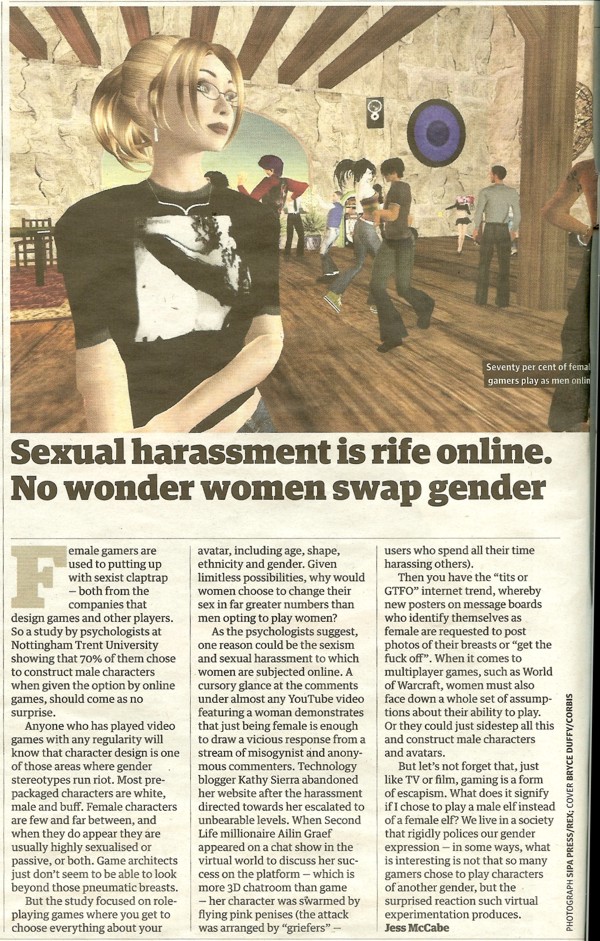
I decided to do some research about female gamers and found this article (Click to enlarge):
The article reviews a study done by the Nottingham Trent University. The study showed that 70% of female gamers choose to construct male characters when given the option by online games. The psychologists conducting the study suggested two reasons for their findings. One was the “sexism and sexual harassment to which women are subjected to online” and the other reason was that “women must face down a whole set of assumptions about their ability to play.” The psychologists are suggesting here that when women play male characters, they have the ability to protect themselves from sexual harassment as well as guard themselves from female gamer stereotypes such as female gamers being lamer and less experienced than male players. This ties into Turkle’s article in that her experience on LambdaMOO corresponds to the study results completely.

Friday, March 28, 2008

Rheingold's "Multi-User Dungeons and Alternate Identies" - Gender Switching

In last week’s reading, “Multi-User Dungeons and Alternate Identities” by Howard Rheingold, MUDs are introduced as “imaginary worlds in computer databases where people use words and programming languages to improvise melodramas, build worlds and all the objects in them, solve puzzles, invent amusements” and much more. As users log on to MUDs they create new identities and/or false identities. Rheingold says, “…the population of online-gender-switchers numbers in the hundreds of thousands.” What he means here is that when users create new identities, there is an overabundance of males creating female characters and females creating female characters. As I read the article, I found it a little weird that this was occurring so I decided to do a little research to find out why users participate in gender switching.

http://www.lubbockonline.net/blogs/duff/index.php?entry=entry071116-091531

I managed to find the blog post above entitled, “Confessions of a gender-switch gamer.” The blog poster, a gender switch gamer, says he plays as female characters when participating in online games. He immediately refutes that he is a man who likes to dress in women’s clothing. When he creates female avatars, he doesn’t think of the female characters as himself, but rather as a story he is watching. This can be compared to fans of popular television shows such as Alias or Buffy the Vampire Slayer. Male fans of the show don’t see themselves as the female characters. They merely enjoy watching the female characters in action. By reading the blog post, I now understand Rhinegold’s statement regarding the heavy appeal of gender switching in the online gaming world.

Saturday, March 22, 2008

Rheingold's "The Virtual Community" - Facebook

Rheingold is back this week in our reading schedule to discuss “The Virtual Community.” In the article, written several years ago during the early stages of the Internet, he introduces the WELL (Whole Earth ‘Lectronic Link) that allows computer users to publicly converse around the world. Rhinegold then goes on to discuss virtual communities. He says, “[p]eople in virtual communities use words on screens to exchange pleasantries and argue, engage in intellectual discourse, conduct commerce, exchange knowledge, share emotional support, make plans, brainstorm, gossip, feud, fall in love, find friends and lose them, play games, flirt, create a little high art and a lot of idle talk.” What he is saying here is that online communities are almost identical to real life communities, except that there are no real physical bodies involved.

The best example of this idea is the increasingly popular, Facebook.com. Although it started as a networking site just for college students, it has turned into one of the largest networking sites in America. It began with just people friending their real life friends. The initial users didn’t understand the dimensions that Facebook could be used for. It allows you to see your friends’ friends, therefore providing users with the ability to network with people who have a common friend. Facebook has now grown and allows people to sell things in the marketplace, write comments to on each other’s walls, poke (flirt with) each other, create graffiti expressions on one another’s pages, create online Facebook group petitions, schedule real-life events and more. Of course, it would take days to list every feature of Facebook. The main idea is that Facebook allows people to communicate and network in ways similar to a real life community, but in a virtual setting independent of their physical bodies.

Wednesday, March 19, 2008

Andrew Keen's "The Noble Amateur" - Citizen Journalists vs. Real Journalists

Our first reading this week was “The Noble Amateur” by Andrew Keen. It was a very interesting reading because it offered a particular viewpoint on how the Internet is damaging our culture. Keen’s main argument in this article is that amateur content creators are bringing down our society by providing misinformation to the masses through sites such as Wikipedia and blogging. He compares journalism to citizen journalism. Citizen journalists are “people who are not employed by a news organization but perform a similar function” to real, educated professional journalists. However, Keen also mentions that citizen journalists “aren’t held accountable for their work in the way real reporters are.” He says here that bloggers and Wikipedia editors can get away with the posting of misinformation while real journalists on television and in newspapers could get fired or put in jail.

A story from my internship at a local news station last summer reminds me of Keen’s statement above. One of the freelance reporters decided to cover a story on a man who was recently arrested on the popular show “To Catch a Predator.” The reporter decided it would be an interesting story if he contacted the man’s neighbors to see how they felt about living nearby to an alleged sex offender. The man arrested had a generic name and the reporter decided to pick a name out of the phonebook in the designated town. It turns out that the reporter chose the wrong man that was arrested and wrongfully accused the man of being a sex offender in his story. This report somehow managed to get on the air because this station was small, and during the weekend the fact-checkers were understaffed. The wrongfully accused man sued the news station for false accusations and the reporter was instantly fired and never heard from again.

It is scary to see how fast a career can disappear before your eyes. This story shows that real journalists are held accountable for their work. If a citizen journalist had decided to do this same story and post it on his blog, I highly doubt the man would have been able to sue the blogger. This ties into Keen’s statement that citizen journalists can get away with a lot more than real journalists when it comes to reporting misinformation.

Friday, February 29, 2008

Jenkins' "Transmedia Storytelling 101" - Cloverfield ARG

Last week we discussed Jenkins’ “Transmedia Storytelling 101.” It was a very straightforward reading, probably because it used current examples of media works unlike the previous readings. Jenkins states that transmedia storytelling is “a process where integral elements of a fiction get dispersed systematically across multiple delivery channels for the purpose of creating a unified and coordinated entertainment experience.” In the article Jenkins says that these stories are expansions of classically constructed narratives that “may add a greater sense of realism to the fiction as a whole.” He says here that transmedia storytelling adds new elements, characters and worlds that go beyond the actual storyline of the original text in order to make it more realistic for fans.

One example of this idea comes from none other than the monster movie “Cloverfield.” Since the movie takes place through the eyes of a character’s camcorder experiencing the monstrous event first hand, it would realistically be impossible for the camcorder owner in the movie to know where the monster came from and what it was seeking as it destroyed New York City. In the movie we only experience the characters trying to escape from the monster. In order to creative buzz, the marketing team at Paramount Pictures put a lot of work into creating a viral marketing campaign/alternate reality game that fans could utilize to learn more of a back-story to where the “Cloverfield” monster came from. Paramount executives created several viral marketing websites such as slusho.jp, tidwave.com, tagruato.jp, Jamieandteddy.com, 1-18-08.com, and character profiles on myspace.com. Fans had the opportunity to learn (or perhaps only speculate) where the monster came from and why it attacked New York City.

By following the ARG I speculate that the monster was awoken by the Deep Sea Drilling company, Tagruato, at the Chuai drilling station located off the coast of Connecticut. Instead of drilling for oil, I believe they were hiding a secret about the drilling of deep sea nectar, the primary ingredient in Slusho slushee drink (Slusho is a subsidiary of Tagruato). As they dug into the ocean floor, the monster was awoken and then decided to destroy the drilling station (seen in the viral news video below). The monster then decided to wreak havoc on the closest land-mass (New York City). However, this is only speculation and the team involved with the movie has yet to confirm or refute this theory.

By creating these viral marketing websites, “Cloverfield” fans had to opportunity to speculate and create a storyline beyond the primary work (the movie) in order to add a sense of realism to the storyline as a whole.

Thursday, February 21, 2008

Jenkins' "Get a Life" - Jericho/NutsOnline.com


Last week’s reading, entitled “Get a Life” by Jenkins, discusses the lives of crazed fans that are obsessed with various media texts. In explaining media fandom, Jenkins talks about the relationship between fans and producers of television shows. He says, “The history of media fandom is at least in part the history of a series of organized efforts to influence programming decisions – some successful, most ending in failure.” Here, Jenkins states an example of fandom where fans of popular television shows band together to form a mass network to get a show that was cancelled back on the air. Usually these “organized efforts” fail in influencing network executives and producers to bring a show back to life. However, some movements have worked in reversing network decisions.

The most recent example that this idea applies to is the CBS show Jericho.
http://www.eonline.com/news/article/index.jsp?uuid=1d118607-738d-4471-9278-1807ac88f4ab

The article above illustrates Jenkins’ idea of fandom. Fans of the popular series were upset when CBS executives decided to pull the plug on the show after putting it on hiatus for a few months and then playing it against American Idol’s timeslot. The fans thought that the network never gave the show a chance and therefore decided to take action. The fans formed a grassroots effort by sending 25 tons of peanuts to CBS offices in New York and Los Angeles. Nutsonline.com was formed and allowed Jericho fans to gather and donate money to send shipments of peanuts to CBS offices. (The nuts were symbolic of a phrase used in the season finale of the show). After dozens of deliveries of nuts, CBS finally issued a statement announcing that Jericho would return to this year’s mid-season lineup. It began airing on February 12 and fans couldn’t be happier. This situation applies to Jenkins’ argument in that the influencing of programming decisions plays a part in the history of media fandom.

Friday, February 15, 2008

Flickr Project: http://www.flickr.com/photos/23721570@N02/sets/72157603904150901/show/

Last Wednesday we completed the Flickr assignment during class. It was fun coming up with an idea to tell a story through pictures. We decided to do a funny story about a girl buying items from the IU bookstore and getting the items for free because she was the 1 millionth customer. Not much preparation went into the project other than charging my camera and making sure I had the proper cable. When we took the pictures in the bookstore, it was very easy to do because there were not too many customers in the store. When we returned to the computer lab it was very easy to upload the photos onto Flickr. It allowed us to easily select which photos we wanted and what order we wanted to put them in. Our project came out very well: click here to view it.


Flickr is a creative tool to share user-created content with others. It enables anyone with a digital camera to post pictures they take and share them with friends, family or just about anyone with access to the internet. Users can create photo sets that can be used to showcase photographic talent, review an event, or tell a story to others. Flickr is unique in that everyone who is a member of the website can view each others photos by subject of the photo, popularity, and other search options. This is what makes Flickr different from Facebook and other private viewing photo collection websites.

An interesting impact of sites like Flickr is that web users now have the ability to participate in citizen-based photojournalism. This type of public journalism through photos allows people to capture "news" stories and instantly send them to the internet community. News in this context can be considered either a big local event that occurred or simply something trivial someone has discovered and wishes to share with the world. Flickr allows citzen based photo journalists to break news to the world faster than newspapers, television or radio. This is due to the fact that now anyone can break the news rather than just people in the broadcast/print journalism profession. This is mentioned in the Rebecca's Pocket blog post. Now that people know Flickr exists, people that own digital cameras are more inclined to document what they see and post it to break the news on the internet.

Wednesday, February 6, 2008

Photoshop for Democracy - Super Tuesday Coverage

In Wednesday’s article “Photoshop for Democracy,” Jenkins tells us that we are experiencing a new convergence culture in that corporate media and new media are merging. He makes the argument that we are in a “transition where the political role of the Internet is expanding without diminishing the power of broadcast media.” By this statement, he is saying that the Internet is beginning to play more of a role in politics. However, this does not mean that the power of broadcast media politics is declining. Rather, they are “converging” in a way of reaching a wider demographic of people.

An example of this is seen in one of my favorite blogs: TV Squad.

http://www.tvsquad.com/2008/02/06/20-random-thoughts-about-super-tuesday-coverage/

TV squad is a blog that has stories about television shows, events on television and real world information about the television business/industry. The blog post above demonstrates the increasing role of politics on the Internet in that people are blogging about politics in general.  In this post we can read reactions to network election coverage.   Reading this we can also conclude that people who continue to watch broadcast political coverage like to blog and comment about it on the Internet. This blog post can serve as information to network election coverage watchers in offering opinions on which broadcast station to watch.  Avid readers of this blog may also read this post and decide to check out the coverage on television.  In conclusion, this blog post relates to Jenkins' idea because there has been an increase in political talk on blogs while also the people blogging continue to watch broadcast political coverage on television.

How to Recognize the Future When It Lands on You - iPhone

In Monday’s reading, “How to Recognize the Future When It Lands on You,” Rhinegold talks about the shift to mobile devices in the world around us. Specifically, he says that people "cooperate in ways never before possible because they carry devices that possess both communication and computing capabilities.” What he is talking about is that for the first time, wireless devices are becoming “smarter” and can do more things. This technological ability is giving technology consumers a new way to communicate and interact with media on-the-go.

The best example of this in the real world is the iPhone. (See video below…a report on the newest iPhone updated software). Released last June, the iPhone is like a miniature Macintosh computer in your pocket. Its interface is very nice and comes with a variety of features. Among the most popular features, the Internet opens up a new way of mobile communication for iPhone users. They can blog, post on forums, and look up information anywhere. For example, last week in class a professor didn’t know the meaning of a word. A girl in the class instantly read the definition from her iPhone before the professor even thought of looking it up on his personal computer.  Never before have students had the ability to access the internet in their pocket at a moments notice.

Let’s not forget this is also a cell phone. Texting has become more popular than ever on the iPhone, especially after the latest software update. Now, iPhone users can send mass text messages to dozens of people (rather than just one at a time like in the past software). Mass texting provides a new way of communication for mobile users in that information can reach many people directly at the click of a button.  As we learned in class, mass texting can be used to notify people of meetings or last minute announcements.  Just last week I received a mass text that I was invited to a party (just hours before it began.  Never before have been people been able to reach so many people in such a short time with assurance they will get the message instantly.

In conclusion, the iPhone is a real life example of Rheingold's idea that people now have the ability to communicate and spread information in ways that have never been possible.

Friday, February 1, 2008

Electronic Community: Fox Attacks Bloggers

Our past reading, “Electronic Community: From Birth to Backlash” outlined the creation of the Internet as a web community. I found it very interesting to learn about USENET and IRC chat as an early means of communication during the rise of the Internet. One argument I found particularly interesting, and I bet many people would question the validity of this statement, is “…the Internet is doing just fine…In the short time Blogger has been available, it has fostered an interconnected community of tens of thousands of users. These people don’t simply surf the Web. They are now empowered to create it” (p. 31).
Most people my age agree that the Internet and blogging are a great way of exercising the use of free speech. Blogs also serve as literature to read as a digital medium. For example, although I do not post very often, I like to read blogs about television, movies and technology. However, according to the video below, FOX News loathes blogging and sees it as an injustice to many industries due to its obscene language. The video was created by “Fox attacks”, a blog (interestingly enough) that dedicates itself to hating FOX news for hundreds of reasons. ¬After viewing the video, I feel like FOX is too harsh on the blogosphere and takes it too seriously. They shouldn’t become offended by the foul language found on blogs.

Tuesday, January 29, 2008

Neil Postman's "Reach Out and Elect Someone" - Hillary Clinton New Hampshire Primary

I enjoyed reading the latest chapter from Postman entitled “Reach Out and Elect Someone.” One argument I agree with is that “we are inclined to vote for those whose personality, family life, and style” are the most favorable among the candidates. I feel that there are many people our there that know squat about politics but choose to vote based on the values of the candidates seen in the media. For example, I remember hearing a few days ago that Hillary Clinton cried in public showing her compassion for the nation. (See Video Below). Immediately following this event, there was mass speculation on several news circuits granting Hillary a victory in gaining more voters just because of her response. This applies to Postman’s argument because people who witnessed this event are beginning to sense that she is an empathetic, strong woman who cares about the nation. Therefore, she is receiving lots of media attention for her reaction that day and many spectators are crediting that moment to her victory at the New Hampshire primary.

Friday, January 25, 2008

Neil Postman's "The Age of Show Business" - If It Bleeds It Leads

I found the reading for “The Age of Show Business” by Postman very intriguing. In particular, one argument he made that I agree with is that a “news show, to put it plainly, is a format for entertainment, not for education, reflection or catharsis” (p. 87-88). After having two summer internships at CBS National News and Time Warner New York City local news, I agree with Postman’s argument because newscasts every night report on crimes, deaths and problems that have little relevance to those watching. After being involved in the “news world” for two years I have learned of the popular saying, “if it bleeds…it leads.” There have been many articles in circulation putting down news broadcasts for their content. Here is one I found very interesting: http://www.fair.org/media-beat/951213.html This article relates to Postman’s views and lists several newscast statistics that you may be very surprised about.

Almost all news programs live by this statement as a way of catching the viewers at the beginning of the newscast to suck them in and keep them for the remainder of the half hour, immersing them in flashy graphics, exciting music and most importantly – lengthy commercial breaks. For those who are not familiar with the television business, commercials that are shown are from the sponsors of each individual show. Television shows cannot function without sponsorship thus all shows on broadcast television depend on commercials to keep their shows on the air. Ultimately, I do not understand why the American public is so fascinated by death and violence. However, I do know that the news producers are very smart and know how to keep your attention focused at all times.

Saturday, January 12, 2008