Wednesday, April 23, 2008

Revision: Julian Dibbell's "A Rape in Cyberspace" - Juicy Campus

Our latest reading entitled “A Rape in Cyberspace” by Julian Dibbell was very interesting. The chapter retells the story of Mr. Bungle committing online sexual harassment to two LambdaMOO characters and the issues that arose from the incident. On page 380, we hear legbda’s (one of the raped characters) reaction to the incident. She says, “I tend to think that restrictive measures around here cause more trouble than they prevent” and suggests that Mr. Bungle become “virtually castrated.” In other words, she wants Mr. Bungle’s character destroyed and wiped from the community. She feels his punishment should be to never show his (virtual) face in the online LambdaMOO community ever again.
One question that can be derived from her reaction is: does someone who “virtually” harasses someone in an online community deserve to be banned from that online community? In my opinion, free speech online is free speech. If legba was offended by Mr. Bungle, she should block his comments or just log off when he tries to contact her. For example, the website JuicyCampus.com is becoming increasingly popular among college campuses across America. The website is totally anonymous and encourages enormous amounts of bashing and gossiping.

To learn more about the website, check out this CBS News report about JuicyCampus: http://www.cbsnews.com/stories/2008/03/26/scitech/pcanswer/main3968514.shtml

If someone was gossiping or bashing me on that website, I merely would stop reading the comments because what I don’t read will not bother me. This is how legba should react to Mr. Bungle’s virtual remarks. Because there is such a thing as free speech in this country, it is hard to punish the person writing the criticizing statement on the web. Sometimes it just pays to be the better person and walk away from incident with maturity. There are hundreds of derogatory posts on JuicyCampus written about people that are even harsher than what Mr. Bungle expressed in LambdaMOO. I bet if people didn’t make such a federal case about the “raping”, the whole community would have quickly moved on. The problem here was that the “rape” victims were too enveloped in LambdaMOO that their reactions and emotions got the best of them.

Another point to bring up here is that if people just ignore that they are getting "raped" or bashed online, the act still continues, however they are just ignorant of it. Everyone else can still read what people say about you on JuicyCampus and remind you of it later. Therefore, there is only so much ignoring can do. Also, it is important to mention that free speech isn't 100% granted. There are some limits such as libel and slander. You can be sued for making up false claims and accusations. Perhaps, JuicyCampus will create outrage in the future that many petitions will form and get it shut down. There has to be a way to prove that the website is unethical and at some points can cross the line of free speech.

Revision: Electronic Community: Fox Attacks Bloggers

Our past reading, “Electronic Community: From Birth to Backlash” outlined the creation of the Internet as a web community. I found it very interesting to learn about USENET and IRC chat as an early means of communication during the rise of the Internet. One argument I found particularly interesting, and I bet many people would question the validity of this statement, is “…the Internet is doing just fine…In the short time Blogger has been available, it has fostered an interconnected community of tens of thousands of users. These people don’t simply surf the Web. They are now empowered to create it” (p. 31). He is implying here that the internet in a good state because people aren't just watching content or reading up on things. Rather, they are creating content for people to watch and writing things for people to read.


Most people my age agree that the Internet and blogging are a great way of exercising the use of free speech. Blogs also serve as literature to read as a digital medium. For example, although I do not post very often, I like to read blogs about television, movies and technology. However, according to the video above, FOX News loathes blogging and sees it as an injustice to many industries due to its obscene language. The video shows a montage of clips taken from several FOX news reports where they criticize the act of blogging. The video was created by “Fox attacks”, a blog (interestingly enough) that dedicates itself to hating FOX news. The video relates to Rushkoff's argument in that it down right disagrees with it. The several news anchors and correspondents on FOX news say that people that blog are too critical, mean and bullying. The video also calls bloggers unreliable. I disagree with them (I agree with Rushkoff). Even though some reports are false, blogging is great because it allows anyone to break a reliable news story 24/7 rather than having to wait for a journalist to find the story, write it up, edit it and broadcast it. That is the advantage bloggers have over journalists.

Revision: Neil Postman's "Reach Out and Elect Someone" - Hillary Clinton New Hampshire Primary

I enjoyed reading the latest chapter from Postman entitled “Reach Out and Elect Someone.” The chapter discusses how politics is just like show business in that the main part of a candidates job while running for office is to APPEAR as if they are honest, respectable and hard working through various forms of media such as commercials. According to Postman, “we are inclined to vote for those whose personality, family life, and style are the most favorable among the candidates." I agree with his opinion in that politicians spend a lot of their during campaigns trying to APPEAR to the country that they are well rounded, like to have fun, but also know how to get the job done.

I feel that there are many people out there that know squat about politics but choose to vote based on the values of the candidates seen in the media. For example, I remember hearing a few months ago that Hillary Clinton cried in public showing her compassion for the nation. Immediately following this event, there was mass speculation on several news circuits granting Hillary a victory in gaining more voters just because of her response. This is because Hillary showed that she is human, thus improving her image.

Also, in April, Hillary continued to show how "cool" she is by appearing in college towns and taking shots of whiskey and chugging beers. She is doing this to change her image to make her look cool and hip so people will vote for her. This applies to Postman’s idea (mentioned above) because people who witnessed these events are beginning to sense that she is an empathetic, strong woman who cares about the nation. They are also showing that she is human in that she likes to drink and have a good time. Every leader needs to be able to sit back and enjoy life sometimes.

Friday, April 18, 2008

Blogging from Las Vegas - Extra Credit Blog Post


So...I missed Wednesday's class and quiz to go to Las Vegas to attend the NAB show! This was such an incredible experience because I had the opportunity to learn a lot about the media industry and network with industry professionals.

On Wednesday, I arrived in Vegas at 8am (Vegas time) and went straight to the Las Vegas convention center. I was incredibly overwhelmed by the size of the convention. It was comprised of 3 large halls (about the size of 2 football fields long each). Each hall was divided into specific areas such as media distribution, audio, production equipment, etc. I was able to check out the coolest gadgets coming out in the next year from Adobe, Sony, Panasonic, Cannon, and many others. It was a very hands on experience because I was able to walk up and touch everything I wanted to.

I was in the minority here (young college student) compared to the thousands of industry professionals. They attended the event for their business to check out new equipment and make purchases for their company. I witnessed a lot of schmoozing going on. It was almost creepy because most exhibits have private rooms hidden for deal making.

I also got to attend a couple Apple training labs and learned how to use Apple Motion, Color, and Soundtrack Pro. There were panels during the day and I attended one on the topic of making small budget movies look like they were on a big budget. I learned a lot about production and post skills at the session.

On Thursday, I attended an awards ceremony where I received my scholarship for all my hard work in school, summer internships and campus activities. It was a great honor to receive an award/scholarship in front of hundreds of industry professionals. After the ceremony, several people walked up to me and congratulated me on my accomplishments. They also offered me their business card. I will definitely need to keep in touch with them.

During both evenings I checked out as many hotels as I could. I stayed at the MGM and really enjoyed the hotel. The nicest overall though, I would say is the Venetian. I also saw the Cirque du Soleil show: Ka. It was amazing! Lots of flying, stunts, pyro, and crazyness.

All in all, it was a great trip. I really felt like a business man going on a business trip and it was altogether a great experience. I will definitely attend the NAB show in the future when I am working professionally in the industry. Hopefully, that will not be the next time I return to Vegas. I would love to come back as soon as possible!

Facebook's "Opt-out" Precedent - Future Jobs/Careers

Last week, we focused on several blog posts pertaining to privacy on social networking sites such as Facebook and MySpace. One post I found particularly interesting was a post about the "opt-out" precedent of Facebook. Throughout the last two years, Facebook.com has been limiting member privacy. First, they introduced the newsfeeds. Second, they allowed profiles to be listed on search engines. Now, when members participate in 3rd party websites (such as Blockbuster), a engine known as Beacon will automatically send a notification to your news feed. Of course, Facebook users have the ability to "opt-out" of the three "features" above. However, most users don't know about it because Facebook automatically enabled the features as they were implemented into the website. Therefore, all users were prone to anyone accessing their information until they changed their privacy settings. This was very sneaky on Facebook's party because, as the blog title states: viewers must Opt-out of these features rather than opt-in to being with.

This is very dangerous, not only for general Facebook users, but also college students looking for jobs, internships or career paths. As Facebook created these new features, companies have the ability to find out everything they need to know about you before they offer you a job. They may find out useless knowledge such as a unique hobby you have or see pictures of you in a bad state of mind. After viewing this content, companies may choose not to hire you because it shows that you have weird/bad qualities about yourself. For example, I don't need people that I know from my professional internships to learn everything possible about me. There are some things that deserve to be kept private. This is not because they are shameful or embarrassing, but rather it is because they are irrelevant to job performance. Years ago, people weren't hired based on their likings or hobbies. Why should it be any different today?

Luckily, I immediately became aware of Facebook's new features and decided to disable them. Since then, I have set up a limited profile that prevents business colleagues from seeing pictures tagged of me and groups I am a member of. I also removed my profile from being searchable through Google and when people search for me on Facebook, they will not see my picture until they a friends with me. Although I chose not to block postings on my wall, I will continue to monitor what people write on it. You can never be too safe when it comes to social networking sites like Facebook. Believe it or not, what appears on your profile may be the difference between getting that next job or not.

Friday, April 11, 2008

Julian Dibbell’s “Mutilated Furries, Flying Phalluses” – A Psychiatrist’s Recommendation


Last week our class focused on Julian Dibbell’s Wired article about the act of griefing in Second Life. Griefing is a full fledged culture in which online players commit willfully antisocial behaviors and offenses in an organized group. The article mentions that when griefers first laid their eyes on Second Life, they felt as if they had hit the jackpot. They immediately began creating offensive theme lands through re-creations of the burning Twin Towers and a hooker crime scene. The main goal of griefers is to get online gamers to realize that the internet isn’t a serious business. As they lurk around and utter obscenities, they constantly bother people and aggravate them. They can almost be compared to bullies in high school.


A blog post I found below, discusses a psychiatrist’s recommendation on how to deal with greifers.

http://news.softpedia.com/news/Griefers-Gamers-Acting-like-Dicks-When-Playing-Online-Why-49974.shtml

To begin, the shrink told the blogger that such anti-social behavior is driven by need of attention. Sounds like high school bullies to me. They strive for attention and feed off of it when attacking their prey. Unfortunately, the shrink says that the only option Second Life players have is to ignore griefers. She says, “ignoring such behavior will result in lack of interest for the griefers to continue such behavior.” I agree with the shrink. If someone was teasing me about something, I think that ignoring them is the best policy. They wouldn’t get any attention from me and feel dissatisfied and move onto their next target.


Thursday, April 3, 2008

Julian Dibbell's "A Rape in Cyberspace" - Juicy Campus

Our latest reading entitled “A Rape in Cyberspace” by Julian Dibbell was very interesting. The chapter retells the story of Mr. Bungle committing online sexual harassment to two LambdaMOO characters and the issues that arose from the incident. On page 380, we hear legbda’s (one of the raped characters) reaction to the incident. She says, “I tend to think that restrictive measures around here cause more trouble than they prevent” and suggests that Mr. Bungle become “virtually castrated.” In other words, she wants Mr. Bungle’s character destroyed and wiped from the community. She feels his punishment should be to never show his (virtual) face in the online LambdaMOO community ever again.
One question that can be derived from her reaction is: does someone who “virtually” harasses someone in an online community deserve to be banned from that online community? In my opinion, free speech online is free speech. If legba was offended by Mr. Bungle, she should block his comments or just log off when he tries to contact her. For example, the website JuicyCampus.com is becoming increasingly popular among college campuses across America. The website is totally anonymous and encourages enormous amounts of bashing and gossiping.

To learn more about the website, check out this CBS News report about JuicyCampus: http://www.cbsnews.com/stories/2008/03/26/scitech/pcanswer/main3968514.shtml

If someone was gossiping or bashing me on that website, I merely would stop reading the comments because what I don’t read will not bother me. This is how legba should react to Mr. Bungle’s virtual remarks. Because there is such a thing as free speech in this country, it is hard to punish the person writing the criticizing statement on the web. Sometimes it just pays to be the better person and walk away from incident with maturity. There are hundreds of derogatory posts on JuicyCampus written about people that are even harsher than what Mr. Bungle expressed in LambdaMOO. I bet if people didn’t make such a federal case about the “raping”, the whole community would have quickly moved on. The problem here was that the “rape” victims were too enveloped in LambdaMOO that their reactions and emotions got the best of them.

Wednesday, April 2, 2008

Sherry Turkle’s Tinysex and Gender Trouble – Nottingham Trent University Study Results

Our latest reading about online gaming talked more about gender swapping. In my most recent blog post, I discussed why men chose women identities for their MUD/Second Life characters. Now I will discuss why women choose male identities. This article began with the author’s retelling of her first MUD experience. Her first character in LambdaMOO was an “it” and she felt very uncomfortable. She was instantly receiving sexual advances and innuendos. Turkle then says, “I wondered if playing a male might allow me to feel less out of place.” She later created a new male character and believe it or not she was approached far less frequently, she felt a new sense of freedom, and she felt altogether less threatened. Here we have a reason why women would choose male identities when participating in MUDs. Turkle was more comfortable as a male character because it made her feel less threatened and harassed.

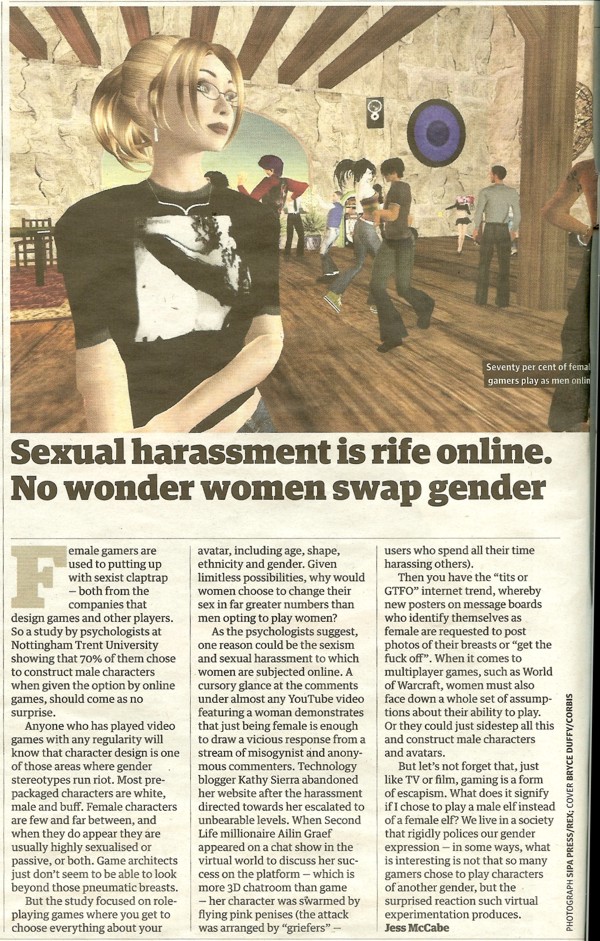
I decided to do some research about female gamers and found this article (Click to enlarge):
The article reviews a study done by the Nottingham Trent University. The study showed that 70% of female gamers choose to construct male characters when given the option by online games. The psychologists conducting the study suggested two reasons for their findings. One was the “sexism and sexual harassment to which women are subjected to online” and the other reason was that “women must face down a whole set of assumptions about their ability to play.” The psychologists are suggesting here that when women play male characters, they have the ability to protect themselves from sexual harassment as well as guard themselves from female gamer stereotypes such as female gamers being lamer and less experienced than male players. This ties into Turkle’s article in that her experience on LambdaMOO corresponds to the study results completely.